MES vs MOM
MES (Manufacturing Execution System) originally described software that tracks and monitors production on the factory floor. Later, the term MOM (Manufacturing Operations Management) emerged to describe a broader, more integrated set of capabilities.
It’s often unhelpful to frame this as MES vs MOM, because both terms sit in the same solution space, and many vendors still use MES because the term is familiar. Conceptually, MES is now best seen as a subset of MOM.
MES and MOM in Industry Strategy and the Smart Factory
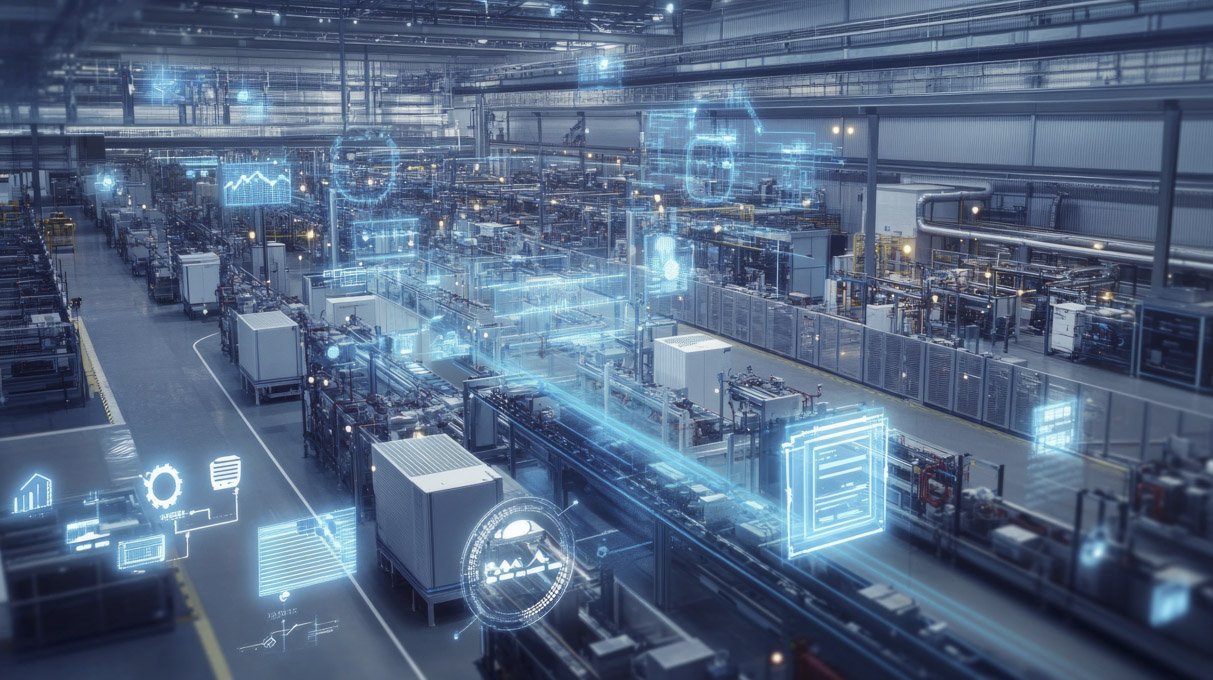
Leading manufacturers align their manufacturing strategy with overall business strategy, so operations can support growth, profitability, and customer expectations. The Smart Factory concept from the Fourth Industrial Revolution (4IR) builds on this by using IoT-enabled technologies to generate real-time data for better decision-making.
MOM provides the broader functionality required for a Smart Factory, such as Advanced Production Scheduling and Quality Management. It includes capabilities once described as MES, such as automated Shop Floor Data Collection (SFDC) using IoT devices, and together MES and MOM deliver the intelligent systems that collect, deliver, and analyze production data.
What is MES?
In narrow terms, MES is a work-order-driven, work-in-progress tracking system that captures information from the production floor. It manages and monitors production events and reporting from order release, through manufacturing, to finished goods.
Many early MES solutions were highly customized and rigid. They often took a long time to implement, were expensive, and struggled to adapt to changing business needs, leading to a reputation for cost and risk that did not always match business outcomes.
What is MOM?
MOM covers a wider scope than MES, extending beyond execution into areas such as quality management, materials management, and maintenance. It provides a unified solution to manage operations across the entire manufacturing enterprise.
Where MES focuses on executing and tracking production, MOM offers an integrated, end-to-end view of production management to drive operational efficiency and excellence. MOM systems connect, manage, and optimize complex manufacturing systems and processes across the full lifecycle.
By integrating production, quality, maintenance, and inventory management, MOM supports digital transformation in manufacturing. It leverages advanced technologies to give manufacturers deeper insights, predict maintenance needs, and improve overall production efficiency.
In simple terms, MES is a subset of MOM – like a dinghy compared with a yacht.
Benefits of using a MOM vs MES
In many areas, MES and MOM deliver similar benefits, including:
-
Production optimization.
-
Recording machine start, stop, and downtime.
-
Event management.
-
Job assignment.
-
Parts and component counting.
Additional benefits of MOM
MOM goes further by enabling manufacturers to capitalize on 4IR opportunities and build a digital foundation for the Smart Factory. It is device-agnostic, allowing staff to interact with the system anytime and anywhere, which becomes increasingly important as sensors and smart devices proliferate.
A robust MOM system is flexible and scalable enough to function as a true enterprise application, typically offering:
-
Advanced Production Scheduling with real-time monitoring.
-
Standards-based integration with ERP systems and industrial automation.
-
A standardized manufacturing data model.
-
Business process management and optimization across manufacturing capabilities.
-
End-to-end quality monitoring and control throughout production.
-
Monitoring of labor and machine costs.
-
Traceability of all materials, components, and finished products.
MOM gives managers and executives visibility into every stage of manufacturing and supports factory digitization with real-time information from devices and machines. It can send alerts to and from the shop floor to enable early intervention and resolve performance issues faster.
How MOM improves manufacturing operations
A MOM system provides the data needed to track metrics such as overall labor effectiveness (OLE), overall equipment effectiveness (OEE), and total effective equipment performance (TEEP). These measures help identify where to improve equipment use and manufacturing efficiency.
A strong MOM platform can support Lean Manufacturing, Six Sigma, and Continuous Improvement initiatives. It can be deployed in a single plant or across multiple sites to deliver an enterprise-wide view of production.
When integrated with ERP, MOM enables business-wide visibility and control, optimizing production activities from customer order through to finished goods. By bringing planning, execution (the traditional domain of MES), and monitoring together, MOM supports better resource utilization, less downtime, higher quality, and more responsive, data-driven operations.