Manufacturing teams often search for solutions to operational challenges while powerful capabilities sit dormant in their existing systems.
A production manager builds Excel spreadsheets to track job costs. A quality director searches through paper records during an audit. A purchasing team buys third-party software to calculate landed costs.
Meanwhile, the tools to solve these problems might already exist in their system.
Addressing this challenge is exactly why we recently hosted Unlock Hidden Value: 18 Syspro Modules Hiding in Plain Sight, a webinar exploring the Syspro modules that are often overlooked and how activating them delivers immediate and measurable operational improvements.
Look at what’s already in your system first
Research performed by Syspro shows that around 60% of ERP platform functionality goes untouched.
Before buying another solution or building another workaround, consider what’s already in your system. Every time you add another tool, another integration or another workaround, you’re adding complexity. More licenses to manage. More vendors to coordinate. More places where data doesn’t quite line up.
Look at the capabilities and Syspro modules you’re currently using, identify the real gaps in your operations and check whether you’re paying for duplicate functionality. The evaluation often reveals untapped depth sitting right in front of you.
Real-world example: When estimates don’t match reality
A metal fabrication shop estimated welding operations at two hours per job, a number that seemed reasonable based on their quoting process. When they started tracking actual production time in Syspro’s Work in Progress (WIP) module, the data revealed something different. Welding consistently averaged two and a half hours across every production run.
The half-hour gap compounded across production runs, directly affecting costing accuracy and margin protection. Pricing decisions based on estimates rather than reality meant leaving money on the table with every quote.
At Syspro, purpose-built means anticipating these manufacturing realities before they happen. Production time tracking comes included with your Syspro platform, giving manufacturers the visibility they need to protect margins and price competitively.
What happens when everything connects to your ERP?
When everything connects, improvements compound. Point solutions are standalone tools designed to solve specific problems, like a WIP tracking system, a costing tool or an inventory management add-on. They work fine in isolation, but they share a fatal flaw: they don’t talk to each other.
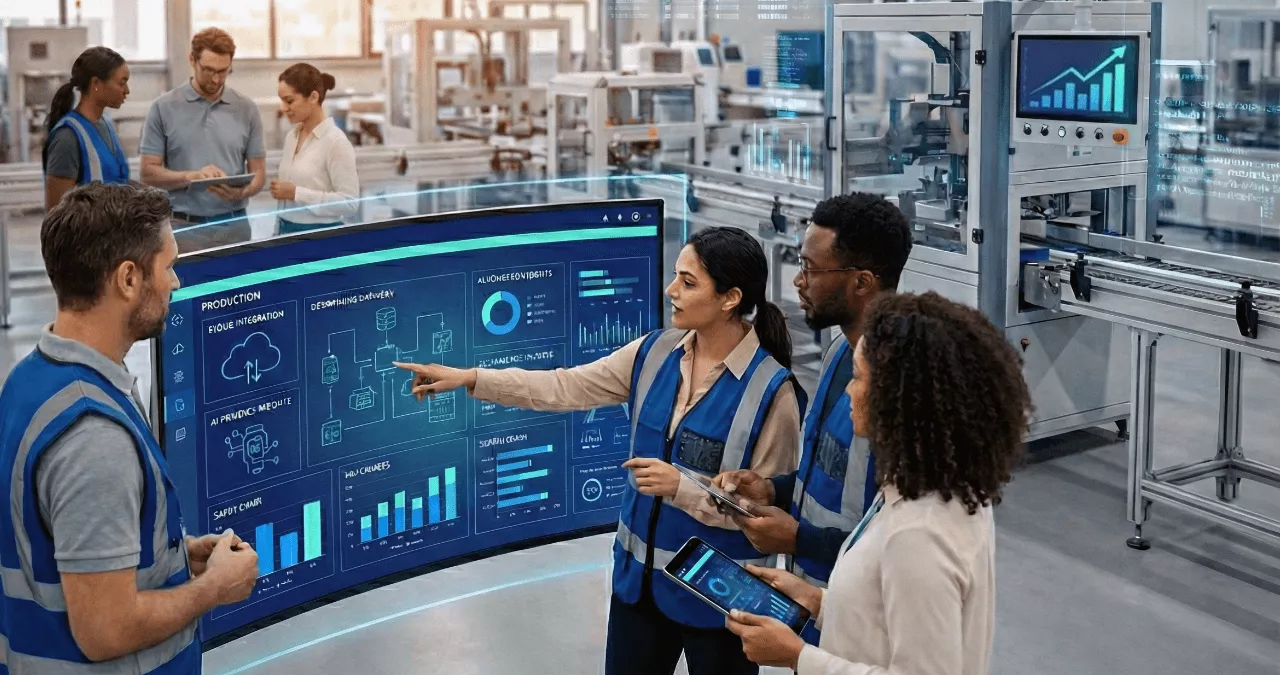
Instead, they create islands where production tracking doesn’t talk to costing, costing doesn’t inform pricing and pricing decisions happen without visibility into true margins. When a shop floor operator posts labor time, that information should flow automatically through costing, update standard costs in inventory and inform quote accuracy in estimating.
Having this interconnection creates cascading value. When Bill of Materials accuracy improves, Material Requirements Planning becomes more reliable. Better MRP reduces excess inventory and frees up working capital.
Real-world example: The 200-hour project that revealed the truth
A contract manufacturer accepted a project they estimated would require 200 hours of work, split evenly between engineering and manufacturing. Using Syspro’s Projects and Contracts module to track the work revealed a different reality. Engineering design consumed 75 hours while manufacturing operations required 125 hours, nearly the opposite of what their initial estimates assumed.
The insight gave them a strategic advantage. They now understood their actual resource allocation patterns, which informed how they approached competitive pricing.
With Syspro modules, the integration works because manufacturing operations work together, with improvements in one area creating value across the entire, unified system.
What if traceability wasn’t a scramble each time?
You get a call about a quality issue from a supplier or production anomaly, and you need to know which finished goods are affected.
The traditional approach involves days of manual searching through spreadsheets, cross-referencing paperwork and hoping you didn’t miss anything. With instant lot-level visibility, you can answer that question immediately.
In the food and beverage industry, this is the difference between finding every loaf of bread made with a specific flour lot in seconds versus shutting down production while you search, allowing you to act fast and precise while minimizing costs and protecting customer trust.
Traceability delivers value beyond crisis management though. The same lot-level visibility that speeds up recalls also improves day-to-day production planning and efficiency.
Real-world example: Planning with lot precision
A medical device manufacturer producing 1,000 surgical utensils checked their inventory and found enough raw material in their current lot to make 500 units. They could run that lot and then switch to another, but that would require job splits and create two different finished good lots for the same order.
Using Syspro’s Lot Traceability, they identified a single raw material lot with enough quantity to produce all 1,000 units, making the process more efficient and easier to track while delivering better results for the customer.
Do you know your real costs?
You might say your product costs $10 because that’s what the purchase order says and what’s in your system. But what about the $3 in tariffs, duties and freight? Those aren’t optional costs; they’re real money leaving your business. If your inventory reflects $10 but your true cost is $13, you’re pricing based on incomplete data.
The landed cost reality
Landed Cost Tracking captures these additional expenses and distributes them accurately across products through honest accounting. Freight invoices, customs duties, insurance and handling fees allocate proportionally across purchase orders. Inventory valuation reflects true cost. Margin analysis becomes accurate.
If your platform doesn’t do this natively, you’re back in spreadsheets trying to make the math work. Someone manually calculates freight per unit, another person tracks duty percentages and a third reconciles everything against actual costs.
Reporting that adapts to your business
Beyond individual product costs, there’s the broader question of financial and operational visibility. Can you report by dimension without restructuring your entire chart of accounts?
A multi-site manufacturer should be able to generate profit and loss reports by location, product line or customer type. Finance needs those insights to make decisions, but creating a chart of accounts complex enough to capture all that becomes a nightmare nobody wants.
Business Intelligence delivers unified visibility across financial, manufacturing and supply chain performance while minimizing blind spots. Analytics surfaces trends through real-time dashboards, Enterprise Asset Management tracks equipment lifecycles and maintenance schedules, Payment Gateway streamlines invoice payments and Inventory Planning with Forecasting and Groupings aligns purchasing with actual demand.
These represent just a few of the often-overlooked Syspro modules with reporting capabilities that deliver measurable operational value.
Which Syspro modules go unused in your system?
More than you might think. Sometimes ERP modules go unused for legitimate reasons. The original implementation team moved on, the business evolved, priorities shifted or maybe a capability was released in a recent update and nobody noticed it.
In the recent webinar, we took a look at underused Syspro modules in detail, including integration capabilities like FileHub for document management and DataSwitch for connecting Syspro with other business systems, along with Point of Sale functionality that supports manufacturers with retail or direct sales channels.
How Syspro modules support resourcefulness in manufacturing
Building for resourcefulness means making more with what you have, and that principle applies to technology just as much as it applies to manufacturing operations.
The capabilities that could help you track production more accurately, manage compliance more effectively or understand costs more completely are already in your Syspro system or available from day one when you choose the platform.
For current Syspro customers, activating these Syspro modules means leveraging your existing investment rather than spending on additional tools. You’ve already paid for the functionality to strengthen operations, protect margins and gain visibility.
For those evaluating platforms, choose a platform where growth means activating existing depth rather than buying additional tools. The difference becomes clear when you compare what comes standard versus what requires costly add-ons, integrations and additional vendors
Want to dive deeper into specific Syspro modules and see real examples?
Watch the full webinar recording for a closer look at the 18 most underused modules included in your Syspro platform. Access the full on-demand webinar here.
Evaluating platforms for your manufacturing operation?
Connect with our experts to discuss your specific challenges and see how Syspro’s depth could work for your business. Let’s chat!