In common with just about every other industry sector, manufacturing organizations are under pressure to adopt AI and to do so at pace. But moving from strategy to implementation is taking place against a backdrop of legacy systems engineered over many years for extremely precise use cases. Unlike other industries that can pivot quickly, manufacturers must innovate while protecting continuity, reliability, and all the operational dependencies that keep production moving.
While earlier digital trends focused squarely on efficiency and repeatability, AI introduces a more fundamental shift. We are moving from machines that execute predefined tasks to systems capable of interpreting information, anticipating outcomes, and supporting complex decisions. For the first time, enterprise technology is beginning to think with us, not merely work for us.
The challenge, however, is not whether manufacturers should embrace AI, but how to integrate it into environments that have been carefully attuned to daily operational rhythms. A misstep risks undermining the very stability manufacturers rely on. Yet hesitation carries its own cost, because AI is no longer speculative. It is rapidly becoming the organizing principle of next-generation operations.
From ambition to reality
The momentum behind AI adoption arrives at a time when the sector faces persistent financial pressure. Make UK’s recent data shows a modest improvement in activity toward the end of 2025, but expectations for 2026 remain muted, with output forecast to stagnate or even contract. In this climate, large-scale system replacements feel impractical and risky.
As a result, most manufacturers are choosing to apply AI in ways that extend, rather than replace, their existing technology foundation. They are focusing on projects with immediate impact, such as improving delivery performance, increasing planning accuracy, or strengthening supply chain resilience. This pragmatic, outcome-led phase is essential, but it is also transitional. Without realizing it, manufacturers are laying the groundwork for the next evolution of enterprise systems: a shift from platforms that simply record what has happened to platforms that help orchestrate what should happen next.
This shift reframes the fundamental question of digital transformation. It is no longer about how much automation can be added, but about how intelligent systems can support operational intent within the boundaries manufacturers already understand and trust.
Balancing opportunity with risk
AI introduces a tension that manufacturing leaders must navigate carefully. Production and supply chain decisions have historically depended on human judgement. On the experience of planners, buyers, supervisors, and operators who understand the nuances of their environment. Now, intelligent systems are capable of interpreting data, diagnosing constraints, and even recommending actions. Enterprise software is moving from passive record-keeping to active participation.
This does not represent a binary choice between human and machine. The most successful AI-enabled environments are those where intelligent agents sit alongside existing systems, helping people understand what is happening now, what may happen next, and how different choices could play out. Instead of executing tasks alone, manufacturers begin using AI to support intent, expressing goals and constraints, and allowing the technology to help determine the most effective path forward.
As this model takes shape, the most impactful AI deployments are not the most dramatic ones, but the ones that enhance judgement within familiar operational frameworks. It is less about transformation programs and more about elevating everyday decision-making.
Putting plans into practice
One of the most significant changes manufacturers will experience is the way they interact with enterprise systems. Instead of navigating interfaces and reports, users will increasingly express their objectives conversationally, asking systems to highlight risks, propose schedules, validate orders, or evaluate trade-offs. This marks the beginning of what many now describe as the “invisible ERP”, a system where interaction becomes natural, contextual, and nearly free of screens.
As this evolves, enterprise platforms will begin to act with controlled autonomy. Rather than waiting for users to request information, systems will monitor operations continuously, surfacing emerging constraints, predicting disruptions, and proposing the best available actions in real time. The industry is already moving past the era of transaction-driven ERP. The emerging model is intent-driven and agent-assisted, where technology behaves less like a database and more like a collaborator that understands context and helps orchestrate outcomes.
Imagine a planner starting the week not by reviewing exception reports, but by asking the system which orders are most at risk and why. Overnight, intelligent agents have already analyzed material availability, labor constraints, capacity, supplier performance, and historical patterns. Instead of returning static data, the system offers a prioritized set of risks and proposed interventions. Human expertise still governs decisions, but the cognitive load shifts dramatically.
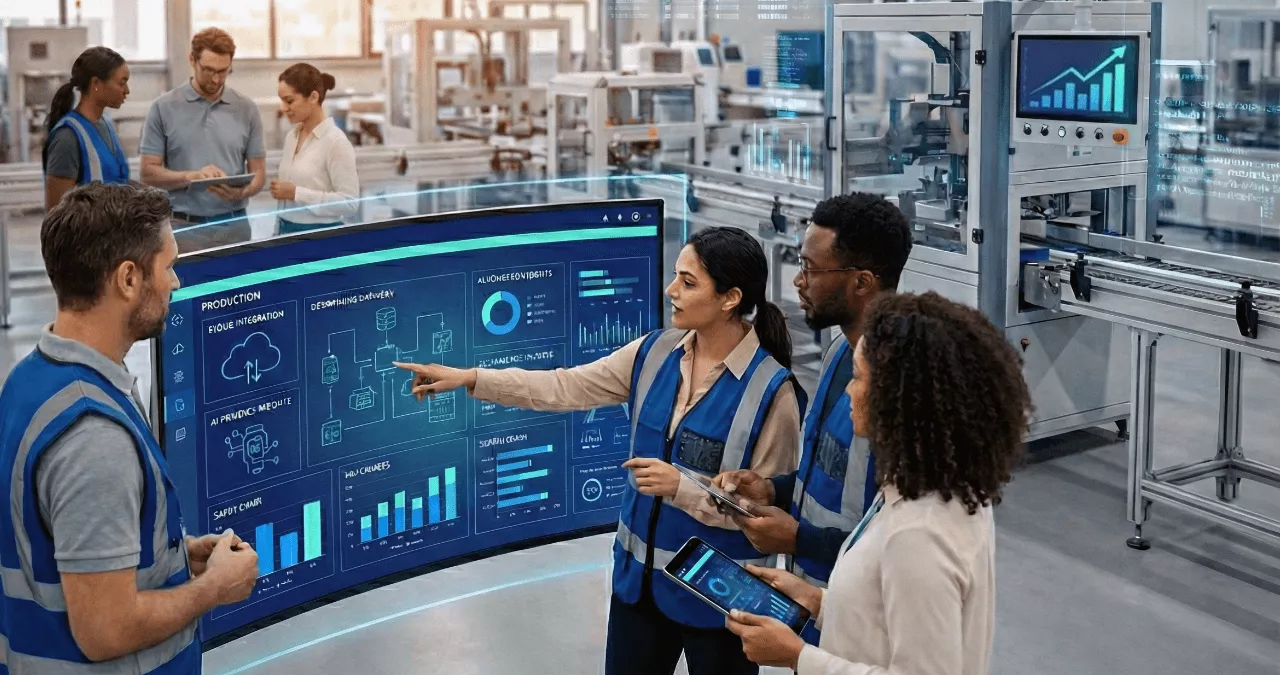
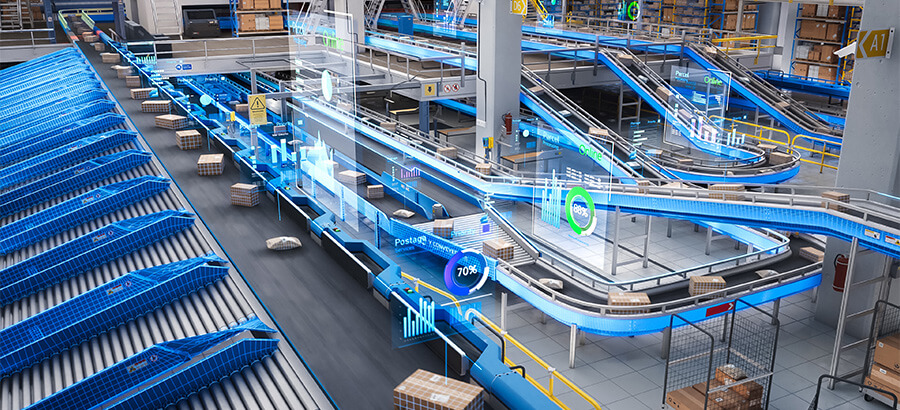
Extend this model across production, quality, supply chain, maintenance, and finance, and a new operational architecture begins to emerge. What can be described as the Cognitive Production Floor. In this environment, agents continuously observe material flows, schedules, bottlenecks, and quality indicators. Anomalies are detected before they reach the shop floor. Schedules adjust dynamically as new constraints appear. The factory becomes not just automated, but adaptive.
Over time, these systems also begin to accumulate an understanding of the organization itself. They learn seasonal patterns, supplier tendencies, maintenance rhythms, and even the decision preferences of experienced planners. This emerging “enterprise memory” will become one of the most powerful competitive differentiators in modern manufacturing. It captures the tacit knowledge that businesses have long struggled to document and applies it consistently at scale.
A redefinition of how work gets done
This evolution does not diminish the role of people in manufacturing. It redefines it.
On the Cognitive Production Floor, AI absorbs information density, continuously scans for risk, and evaluates scenarios. Humans apply judgement, navigate ambiguity, and determine strategy. The shift is not toward fewer people, but toward people doing the work that draws on distinctly human strengths, supported by systems that make the complexity of modern manufacturing more manageable.
A new era, already underway
AI in manufacturing is no longer an experiment at the edge of the organization. It is steadily becoming the architecture of the organization itself. The manufacturers who move first, not with massive replacements, but with targeted, high-value agents that prove ROI, will be best positioned for the shift ahead.
They are preparing for an operating model where intelligence is continuous, where complexity is absorbed by systems instead of people, where decisions are informed by cognition rather than intuition, and where the factory becomes not only automated, but truly aware.
This is not the evolution of the production floor. It is the emergence of the cognitive one and it is far closer than most manufacturers realize.